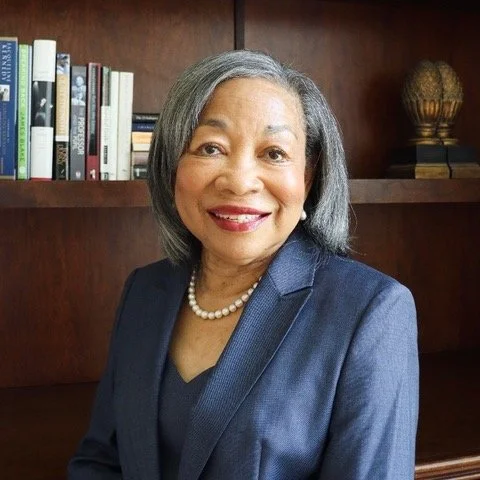
I was standing on the field at Truist Park, where the Atlanta Braves host an annual HBCU Night in August. This event honors presidents at Historically Black Colleges and Universities and salutes the positive impact of HBCUs on our communities. As my name was announced, I walked out and waved to the crowd, trusting that my strength would hold out through the night. But the distance I had to walk from the viewing box to the field, and then back up to the box, seemed infinite. My feet and legs felt like cement blocks. I slowly dragged them up and down the stairs and ramps to the field. Later I told my husband George that I was glad I didn’t have to do this again until next year.
As the fall semester progressed, my health deteriorated. Six years ago, I had been diagnosed with amyloidosis, a rare blood disorder where stem cells in the bone marrow produce amyloid proteins. These proteins build up in organs such as the heart, liver, and kidneys. The type of amyloidosis I have (AL type) affects less than 13 people per million per year.
Dr. Mishra, my cardiologist at Emory, had referred me to Dr. Barry, a heart doctor at Houston Methodist Hospital who was a specialist in amyloidosis.
“Get to Houston as soon as you can,” Dr. Barry said.
I looked at my calendar for the last day of classes. “Okay, I’ll be there during the first week in December,” I told him, deciding that I would finish the semester before departing on medical leave. My mind was racing with thoughts of transitioning my responsibilities as president of Tuskegee to others during my absence.
Dr. Barry looked at me sternly on the Zoom call. “No, you need to come right away, within the next week or two.”
I wonder if he saw the glazed look in my eyes; I wasn’t expecting to hear this. It was six years since my stem cell transplant, and my lab numbers were really bad. The amyloidosis had caused me to have heart failure and kidney damage. I needed to get to Houston Methodist Hospital for two organ transplants. Of course, I knew my condition was serious—some days I would be so tired when I got home from work that I would sit in the car for 30 minutes to gather my strength before walking up the stairs to the front door, one step at a time with my daikon ashi legs (a Japanese term for legs that look like the daikon radish—thick and unattractive). When I was 11, I opened the gate to our yard for Reiko, my mother’s friend. She looked at me in my red tank top and denim shorts and exclaimed, “Lee Lee-chan! You have big legs, daikon ashi legs!” I cringed, thinking how could she say that to me?! That did not sound like a compliment. Now my daikon ashi legs were a hundred times worse than when I was a girl. Water retention had caused elephant ankles and extreme swelling throughout my leg. They were not a pretty sight.
Though this was the second time I had a Zoom appointment with Dr. Barry, I felt like he knew me. He read all of my medical records, and had spoken several times to Dr. Mishra about my case. Dr. Barry was young, maybe forty-ish, with thick “cool guy” hair (like Harry Styles!). He wore dark brown rectangular glasses and had a brown moustache and trimmed beard. A cardiologist with a specialization in heart transplants and amyloidosis, he had the perfect credentials to treat patients like me. We quickly built a rapport, and I trusted him. I knew that my life was in good hands.
After we ended the appointment, I looked around my home office, taking in all the books, photographs and awards I had collected over the 30 years of my academic career, and wondered what would happen next. And I thought about how I would go about preparing for my imminent departure during the COVID pandemic. Suddenly being protected from COVID overshadowed all of my fears—what if I got COVID before I had my transplants?
George was downstairs, eating lunch—one of his favorites, a Subway tuna sub with lots of onions, potato chips and unsweetened iced tea. I sat down next to him and shared my news. Houston Methodist. Leave soon. Start packing. At first, he thought “leave soon” meant the end of the semester (just as I had), so I got specific: “Like in two weeks, we have to be there. We have a lot to do.” Then I just cried. “It’s happening, it’s really happening …. I can’t believe it…. Two transplants!!” George held me in his arms and told me we’d get through it together, that I wouldn’t be alone. That I was going to the best hospital to get my medical care. On most days, I’m strong and resilient; I don’t let things get in my way. But now I felt like a frightened little girl. I wasn’t used to feeling that way.
I looked at the portrait of my mother, Kazuko. She grew up in Gunma-ken, a small countryside town on the outskirts of Tokyo and her childhood was punctuated by World War II, where sheltering from air raids and firestorms was an everyday part of life. She is fourteen in this portrait. It is after the war. Kazuko is wearing a silk steel blue kimono with over a dozen rows of red, white, and blue poppies. When I was ten, she shared a Japanese proverb with me and my brother Junior about courage, resilience, and perseverance: “If you fall down seven times, get up eight times.” No matter how many obstacles you face, true courage and strength mean getting up and persevering one more time than you fall. I learned about strength and stoicism from my mother who survived the war and carried the memory of charred bodies floating in the Sumida River. She lost both her parents at a young age and faced discrimination in Japan because she married a Black soldier. When she came to the U.S. in 1957, she drank from colored water fountains in North Carolina. “What can I do? That’s the way it was.” She would take a puff of her Salem cigarette, and look away, as if remembering lives lost. Mommy rarely spoke about her feelings. What good would it do, she asked. In many ways, I am just like her: stoic, calm, quietly expressive about my feelings, and determined. And these qualities allowed me to face all of the challenges in my life.
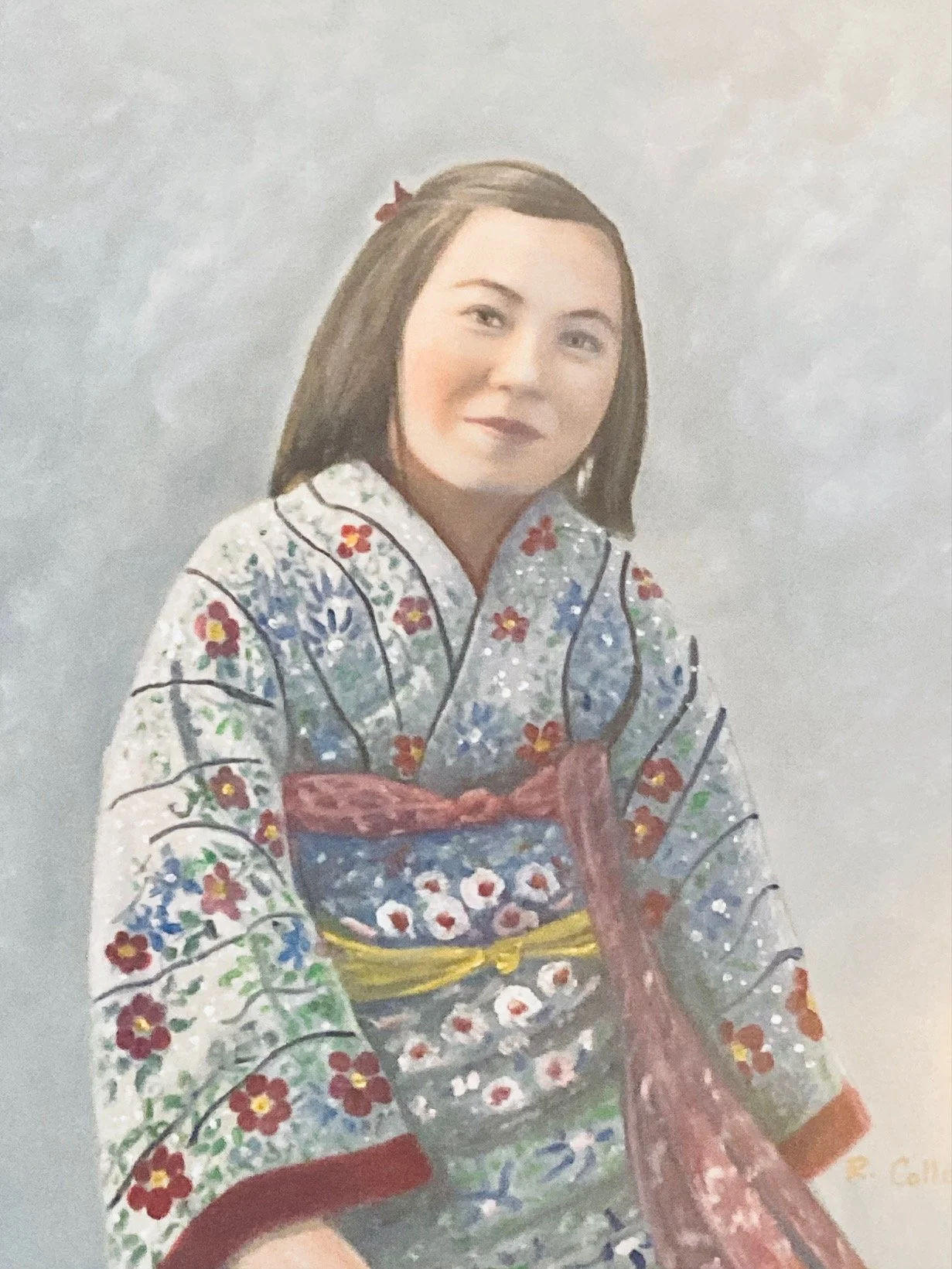
Portrait of Kazuko from the private art collection of Lily McNair-Roberts and George Roberts
After talking to Dr. Barry, the Kazuko in me came out full force, trying to silence the frightened little girl.
George helped me get it together, because I had to go back upstairs to my office, and get on another Zoom call, which is how we conducted business throughout COVID. The pandemic hadn’t been declared yet, but COVID was surging. I headed a COVID taskforce at my university the summer before to protect our students, faculty and staff, so I knew how risky it was to travel by plane and have close contact with people, even in a hospital. So, we decided to drive the 12 hours to Houston.
My “transplant sisters” went on the road with me: Lena, a sister psychologist and friend of 20 years who had a heart and kidney transplant and knew exactly what I was facing, and my younger sister Omi who would donate one of her kidneys to me four years later. They weren’t on the road with me to Houston physically, but in my spirit and heart. I spoke to them often, telling them where George and I were on the route, how I was feeling, what I was eating. I’d share the sights—the lush bayous in Louisiana, the flat plains of Texas with the huge oil refineries, and the sign that proclaimed “Welcome to Texas,” and “Drive Friendly—the Texas Way.” Lena would tell me to stay away from certain foods—especially those containing phosphorus, they were bad for the kidneys. Omi cautioned me to avoid fried foods—because they’re just bad, period. They were delighted when we arrived in Houston and both told me to rest and take care of myself. They knew to contact George if need be.
The last time I had to pack for six months was when I left for college. I lived in a small New Jersey town, near Mirror Lake. Then, I was so excited to leave home that I bought two suitcases early in the summer, as soon as I earned the money to pay for them. Two yellow soft side Samsonite bags. I made lists of what I would take: clothes (for classes, going out, working out), books, typewriter, turntable and speakers, and my 21 albums! Mommy gave me food and snacks to have in my dorm room. As a special treat, she packed Botan Rice Candy, a Japanese candy that reminded me of childhood. Each little box had a tiny toy; my favorites were the rings. Daddy and I packed all of my precious belongings into his huge royal blue Newport Chrysler before we left at nine in the morning for our 40-minute drive to Princeton University. We drove mostly in silence. Daddy didn’t engage in small talk. He rarely joked, he was clearly a military man. Disciplined, unemotional, focused on getting things done. I don’t think he ever told me he was proud of me for going to Princeton. He thought I should go to Burlington County Community College, which was “nearby and didn’t cost that much.” And he told me so when I applied to Princeton.
I told Mommy I wanted to attend Princeton when I was eight years old. I saw a news report on television announcing that the son or nephew of a famous man in Japan just graduated from Princeton. “If’s it good enough for him, then It’s good enough for me!” “But they don’t let girls go to Princeton, Lee Lee,” she said. Looking back, I can’t believe how feisty I was. “When it’s time for me to apply, they will let girls in, so I’m going!” “But Princeton costs a lot of money. We don’t have that kind of money.” That didn’t stop me. “Well, I’m gonna get good grades and I’ll get scholarships!” I said all of this calmly—one would think I would be stomping my feet on the floor. And that is exactly how it happened. Princeton admitted women in 1971. I started at Princeton four years later, in 1975. I received scholarships from various sources to attend the university, and my parents paid $200 each semester for my college education.
My father prepared me well for succeeding in college. Throughout my childhood, he bought books of every kind—psychology, physiology and anatomy, an atlas, novels, and a set of encyclopedias. Reading these books opened a new world to me and going to Princeton was the next step in exploring and experiencing this world. So here we were, driving to Princeton: my dream and heart’s desire were coming true and I was determined to get everything I could from my four years there. Daddy drove me to campus, took my luggage and boxes out of the car into my room at 211 1901 Hall, and then drove home.
I thought about my first trip to Princeton University as George and I started our journey to Houston. Of course, this was a different challenge, one for which I wasn’t prepared. But I didn’t let that deter me because that is where I would get a new heart and kidney. Though Omi would be my living donor for a kidney transplant, she would fly to Houston for the surgery. After the transplants, I had to be monitored by the doctors for at least six months. Regular heart biopsies, blood work and echocardiograms. I imagined the things that I would need in Houston: shirts that buttoned up the front, sweaters to wear over those shirts, comfortable loose pants and shoes, a winter coat and hat, and notebooks from work in case I needed to respond to work emails. Silly me, I even packed two red and gray sweaters with embellished collars and crystal buttons for the Christmas holidays (I never wore them, because I dressed in green hospital gowns during my entire hospital stay. I always overpack).
We left for Houston on November 3, 2020, Election Day, where Joseph Biden and Donald Trump were on the Presidential ticket. George and I had voted by absentee ballot, one of the many important tasks we had to complete in the previous two weeks. We packed his car with stuff for a prolonged stay in “The Heart City,” a nickname for the generous city that welcomed Hurricane Katrina evacuees. Houston was most certainly “The Heart City” for me.
“This is a lucky room,” said Daisy, the nurse in the transplant unit, as she helped me settle in. “The last person who stayed in this room got his transplant in a week.” I’ve been in many hospital rooms, many of which were drab and designed in boring hospital blues and greens. I looked around my new place—my home for an undetermined time. Big windows overlooking the Houston skyline and the zoo in the distance allowed lots of sunlight into the room. There was a cobalt accent wall; the other walls were a calming sky blue. I thought, this would be my lucky room while I underwent extensive testing and evaluation for my transplants.
I just knew that I would beat the odds and get both heart and kidney transplants. There are 107,363 people waiting for hearts, livers, and kidneys. Approximately 6,000 people die while waiting for an organ transplant. The month before, someone I know from college died while waiting for a heart transplant. I thought about him often while I waited. About 13 people die each day waiting for a kidney transplant. Lena was blessed; she had a living donor who was one of her colleagues at work, and is now her “kidney sister.”
Once Daisy left, I closed my eyes and sank into the bed. I realized I needed to call my father; I had been calling him every day since October, when he began hospice care. We would only talk for a few minutes, and it was always good to hear his voice asking me how I’m doing. I didn’t tell him about my heart transplant. He didn’t need to know, and he didn’t need to worry about me. My father was at the end of his life, going through an enormous transition. I did tell him about my amyloidosis in 2014; he handled that pretty well. He once sent me a birthday card in which he wrote, “I’m so sorry you have such a terrible disease that caused you to have to go to Boston for treatment.” As I called him from the hospital, I tried to sound chipper while asking him about his day. He said, “Omi came over last night and brought me the juice I like.” At the moment I hung up, a wave of pure exhaustion overcame me and pushed me to the bottom of the ocean floor. All I wanted to do was sleep, sleep, sleep.
George was staying in the Houston Medical Center Marriott directly across the street across from the hospital. George visited me every afternoon. His new routine was to pick up his lunch either in the hospital cafeteria, or get take out from a nearby restaurant, and spend the rest of the day with me. One of George’s love languages is food—he surprises me with food I love as another way of saying he loves me. “I brought this for you, Lily! This is the best red velvet cake I’ve ever had!” That reminded me of a little kid bringing a cupcake he decorated to his mother.
George was dealing with a lot of stress—a markedly different kind of stress than he had ever known before. He had no way to prepare for what was happening to us. The way he dealt with it was by being optimistic and focusing on his and my faith in God. At times when he was anxious, he did not show that to me because he didn’t want me to worry about him. His imagination about my condition only made him feel worse.
George lived between my hospital room and the hotel, and he often brought food for me. It was something he could plan, something over which he had control. He usually offered to share his food with me. “Have some French fries; these are really crispy!” I kept telling him that I was on a “strict diet.” My doctors were adamant about me losing water weight before my transplants (goodbye, daikon ashi legs), so I had to stay away from high sodium foods. I had blood draws every day as they monitored my sodium, glucose, and potassium levels (as well as other electrolytes and measures of heart, liver and kidney function). Still, he kept trying to sneak desserts in—“I brought you a surprise! I know you will love this! Your doctors won’t know you ate this!” I called him a “food pusher,” and yes, my doctors would know if I had cheesecake the day before, because I’m on a heart healthy diet!
Two days after being in the hospital, George called me early in the morning to tell me that my father made his transition. The day was November 7th. He died at the JFK University Medical Center in New Jersey. Omi and David saw him an hour later, his 110-pound body barely taking up space in the hospital bed. Daddy’s life was over, and he was together with my mother again, after being apart for 13 years. Now, I didn’t have either of my parents, and I let that thought sit with me while I imagined what would happen to my life while I was here in room 423 of the J. C. Walter Transplant Center. I prayed that I would get my heart and kidney transplants and walk out of here as a Wonder Woman. I prayed my parents would watch over me and give me the strength to endure surgery and thrive during recovery. Then I could celebrate Christmas and New Year (belatedly) with my family when I was discharged.
I asked the hospital chaplain, Reverend Baldwin, to pray with George and me. After the prayer, he started singing “Great is Thy Faithfulness;” George and I joined in, crying as we experienced God’s hand touching us that afternoon. I confessed to Reverend Baldwin that I felt guilty because someone had to die for me to receive the organs that would save my life. I vowed that my life would be a testament to them.
Every day I underwent a new procedure or test to evaluate me for the transplants. Doctors updated me each morning during rounds. The first update literally knocked me off my feet: my liver was cirrhotic, so I also needed a liver transplant. I was shocked, because I’m a social drinker, rarely drinking alcohol since my stem cell transplant. Congestive heart failure can lead to cirrhosis of the liver. Initially, the physicians discussed my having all three transplant surgeries at the same time. A three solid organ transplant was highly complicated, risky, and very rare. They discussed the pros and cons, with the cons eventually outweighing the pros. My kidney function was actually better than expected, so this surgery was put on hold until later in the spring.
Some of the tests were new, and strangely enough, I enjoyed learning about them. What would the doctors learn that made them vote “yay” or “nay” in approving my transplants (remember, I’m a nerd!)? My curiosity made every appointment an adventure. I discovered different units of the hospital, sometimes going to the Spurlock, Smith, and Jones Towers. The art work on the way was hopeful and beautiful—murals, art by patients and children in bright colors, some with written messages about hope and survival. Emily Dickinson’s poem “Hope is a thing with feathers” framed on a waiting room wall captured my attention. I read the poem over and over during my stay to reinforce its message of hope and resilience. In the skywalks, I watched physicians making beelines to their next appointments, while others sauntered in pairs, apparently engrossed in conversations regarding medical issues.
The week before Thanksgiving, Houston Methodist Hospital imposed a “no visitors” policy due to the surge in COVID-19 rates. Hospital executives stated that the next six weeks—the holiday season—would be critical in stemming infection rates. George and I communicated via phone and Facetime calls and text messages. Those days were very scary—the number of patients with COVID increased daily; temporary ICU sections and rooms were established, travelling nurses were hired. Even with strict mask policies and cleaning and sanitizing protocols, everyone was keenly aware of the infection in the hospital. I would not let COVID take me with its greedy hands.
COVID hung over the hospital like a daunting gray cloud of doom and dread. I read newspaper reports of COVID rates in Houston and the various hospitals in the city, and felt assured that Houston Methodist had a well-planned COVID protocol and policies covering all the bases: developing more triage teams to assess patients with COVID-like symptoms; identifying areas that would be dedicated to patients with COVID; ensuring there were ample supplies of personal protection equipment, and developing safety protocols for food preparation, delivery and storage. I was extremely happy (and relieved) to be in this hospital.
Still, the fear of COVID was palpable. One nurse told me that her mother had about 20 family members and friends over for Thanksgiving dinner, including several who flew in from other cities. The next Tuesday after Thanksgiving, her aunt called her mother to say she had COVID, “I’m calling everyone who was at your home to make sure they get tested, and tell them don’t ignore any of the symptoms.” Nurses talked about how the hospital was running out of open beds. Some staff members shared that there were only one or two ICU beds available that particular day. A “Beware of COVID” sign was buzzing around in my mind. “What if……someone rides the bus to work and sits next to someone with COVID and brings the virus into my room? What if the person who brings my meal tray in, takes the lid off, breathes onto my pancakes and turkey bacon, and has COVID? What if the person who made the pancakes and turkey bacon has COVID?” To keep my mind off of these intrusive thoughts, I turned on TCM (Turner Classic Movie).
On Thursday, December 3, I was placed on the transplant list for a new heart and liver. Two weeks later, on Friday, December 18th, my nurse Amy said, “You’re going to get a phone call this evening. Answer the call!” She was smiling and had an excited look. “Remember, take the call!” Dr. Barry came in afterwards and told me that I would get an offer, and to accept it. Around 6 pm, my cell phone rang from an unknown number. My heart was beating a hundred miles a minute, and I knew it was THE phone call that would change my life forever. Someone from the United Network of Organ Sharing told me that I got an offer for a heart and a liver, from one person who was on life support, did I want to accept the offer? “Yes! Yes, I will accept the offer!” I was thinking about Lena and how she felt when she got THE call.
I immediately called George, crying through tears of happiness. Then Randall and Rebecca, my siblings Jr., David and Omi. I asked George to let Lena know, I was too tired to make any more calls. “I can’t believe this is really happening!” I cried out over and over again. Everyone asked me if I was scared to have the surgery. “No,” I said. “I have the best doctors in the world, I’m looking forward to it!”
But privately, I remembered complications from my autologous stem cell transplant at Boston University Medical Center six years earlier. It was an outpatient procedure. Mommy was with me in Boston. She watched over me when my blood pressure was so low that the doctors (and George) worried that I might not make it through the night. She held my hand when there were blips in my medical status, requiring emergency room visits and two hospitalizations. She made me turn from anger to laughter when a nurse asked me if George was my son!
Between Friday and Sunday, I had more repeat tests to ensure I was physically prepared for surgery. The golden hour came, six o’clock in the evening on Sunday, December 20th. George was with me as I was transported to the surgery suite in my hospital bed. Nurses and doctors came out of the patient rooms to wish me well. They clapped and waved as I passed by; they were cheerleaders, cheering for me in a hallway pep rally. It was a surreal experience—I felt like I was floating through the hospital, seeing hazy colors and bright lights above me, having hazy thoughts about the end of this surgery. When we reached the operating suite, George left me for the waiting room. He kissed me and said, “You’ll be fine, Lily, and I’ll be there when you finish. You’ll have a new life soon.” He was brave and strong.
I felt like I was in a dream. The dazzling lights of the operating room, the team of about 12 surgeons, anesthesiologists and nurses; many tables of trays with glistening silver instruments (scalpels and scissors of all sizes!) greeted me as I entered the room. I recognized some of the physicians, said hi, counted backwards from 10, and I was out.
Christmas Eve, a day of anticipation and frenzy, when kids eagerly await festivities and adults scramble to finish preparations for the big day, was the day I slowly opened my eyes and looked around a new hospital room. I couldn’t move. Britanny, my nurse, asked, “Dr. McNair, are you okay? How do you feel?” My voice was hoarse; I tried a few times to speak, then whispered, “did I really get a heart and liver transplant? Did it really happen?” She confirmed I did, but I still asked again. “Really? Really? Are you sure?” I finally believed it and marveled that I actually had someone else’s heart and liver in me. They were chosen for me. I was awed by this medical miracle.
I was amazed when I realized I woke up on Christmas Eve. “This is the best Christmas gift I’ve ever had! Christmas is my mother’s birthday,” I told Britanny. My mother gave me the gift of life when I was born sixty-three years ago, and now she gave me the gift of a new life on her birthday. I felt her presence everywhere around me.
The next morning, I dreamed that people were in my hospital room, talking behind my bed. The dream was so realistic, I felt that they were actually there. They were discussing the medical appointment their loved one had. It seemed like they were in a makeshift waiting room. They spoke English with an Asian accent, Japanese or Chinese, I wasn’t sure. An older woman and man, accompanied by two young women and a man. When Brittany came in, I asked her if there were Asian people in my room talking earlier. She was very sweet and said no. But I knew that they were there, in spirit. They were my mother and my ancestors watching over me, protecting and comforting me on my journey to a new life.
My hope, courage and optimism don’t come from me alone, but from those in my family who have gently guided me on this path since I took my first breath. Kazuko and Cameron were there. They raised an inquisitive little girl who became a woman who is kind, resilient, and has big dreams. George, my kids, my siblings, my transplant sisters—they are all a part of me. I am the person I am because of all of them.
When the sleet pinged the windows in our Houston apartment, the mild winters of Texas suddenly morphed into the Northeastern winters of my childhood. Snow was on the way. Three weeks after I was discharged from the hospital, the Great Texas Freeze, also known as Snowmageddon, ravaged Texas. From February 13 to 17, the storm caused catastrophic damage: power blackouts, water shortages, frozen pipes, tornadoes, and loss of lives. Because we lived very close to Houston Methodist Hospital, which has its own independent energy system, we were fortunate to have power during this storm.
Being without water for two days, though, was a challenge amplified by a perfect storm of issues, including the COVID pandemic, my compromised immune system and lack of resources caused by winter Storm Uri (gasoline and food shortages). We prepared for the storm by stocking up on bottled water for drinking, cooking, bathing, and flushing the toilet. But how can you stay healthy and clean without water?! That was my job as a newly transplanted person—stay healthy by eating nutritious food, drinking lots of water—at least two liters of water per day, and getting enough rest.
Water is essentially the key to life—not just for me, but for all humans, and all life that is carbon-based. The physiological functions of water keep us alive—humans can survive for only a few days without water. Oceans make up about 97% of our planet’s water, signifying its omnipresence. To be without water is a death sentence.
Despite depending on bottled water, I had to drink, drink, drink. My routine blood work post-transplant indicated whether I was hydrated or not, and this also showed up in my creatinine levels. Lower hydration equals higher creatinine, which is bad. This was particularly important because I was on dialysis for 10 weeks after my transplants. Kidneys tend to “shut down” after this surgery, so dialysis three times a week was part of my regimen. And at each session, blood was drawn.
Texas slowly emerged from the Deep Freeze by February 20, when temperatures rose to above freezing. I celebrated two weeks later by finishing dialysis! My kidney function had returned, so I started a new schedule without the 6:30 to 10:30 am dialysis sessions three times per week. This schedule included getting more sleep on those days!
While I was on dialysis, I spoke to Lena several times about the exhaustion I felt afterwards. She had dialysis before her kidney transplant, and I couldn’t believe she drove herself to and from those sessions. One of the differences, though, between my exhaustion and the pre-transplant exhaustion was that after a few hours of sleep, I felt fine! I always looked forward to going to bed for a blissful nap after my dialysis and waking up just in time for dinner. Lena cheered me on and told me that I would be okay, that this, too, shall pass. As I drifted off to sleep, I would often hear my mother’s voice reminding me “If you fall down seven times, get up eight times.” The Kazuko in me came out full force, silencing that frightened little girl, time and again, even when I lost one of my greatest cheerleaders five years later. I would get up with Kazuko when I received a late night text message that my transplant sister, Lena, had made her transition.
Contributor Notes
Dr. Lily McNair-Roberts is a 2026 Kweli Scholar, with a 30-year career in higher education. Most recently, she served as the eighth and first female president of Tuskegee University. She has written over 40 academic articles and has co-edited four editions of Women: Images and Realities. A Multicultural Anthology of Women in the United States. She has held academic positions at the State University of New York at New Paltz, The University of Georgia, Spelman College, and Wagner College.
A clinical psychologist, Dr. McNair-Roberts specializes in the treatment of anxiety, depression, and the psychological effects of sexual abuse. She has also conducted research in gender-related differences in alcohol use, and developed empirically supported community programs to reduce adolescents’ alcohol use, lower health risks associated with adolescents’ unsafe sexual practices, improve parenting skills and parent-child communication, and strengthen marriages in African-American families.
Dr. McNair-Roberts is a graduate of Princeton University and Stony Brook University. She loves reading biographies and science fiction, planting flowers, and cooking tantalizing foods from around the world.